Bali Makes Most Business Types Unavailable to Foreign Investors
If you have been thinking about setting up a business as a foreigner in Bali soon, there are major regulatory changes you need to know about. Before jumping into the details of the update, it is crucial to understand the context of how business licensing works in Indonesia.
To legally operate a business as a foreign investor, you must establish a PT PMA (Perseroan Terbatas Penanaman Modal Asing), and every PT PMA is required to apply for the appropriate business license corresponding to its activities. In Indonesia, these business activities officially are classified using the KBLI (Klasifikasi Baku Lapangan Usaha Indonesia), which is a 5-digit standardized coding system used to categorize every single business sector.

Every foreign-owned company (PT PMA) must obtain the correct KBLI classification to legally conduct business activities in Indonesia.
Importantly (and this is where the change is happening), under the current Risk-Based Approach (RBA), the government assigns a specific risk level to each individual KBLI code based on its nature and scale of operations. This risk level determines exactly how complex your licensing process will be through the online registration portal (OSS). The current RBA framework classifies businesses into four distinct risk levels:
Low Risk (Rendah): Standard, low-impact commercial activities. Under normal circumstances, these businesses do not require a complex approval process and legally only require a basic Business Identification Number (NIB) to initiate commercial operations. For example, a traditional brick-and-mortar retail store under KBLI 47111.
Lower-Medium Risk (Menengah Rendah): Activities with a slightly higher operational footprint but still relatively low impact. These require an NIB plus a self-declared "Standard Certificate" (Sertifikat Standar) generated automatically through the OSS system.
Upper-Medium Risk (Menengah Tinggi): Sectors that require official verification. These businesses receive their NIB, but their Standard Certificate must be actively verified and approved by the relevant local or central government ministry before they can legally operate.
High Risk (Tinggi): Operations that directly impact public safety, human health, environmental sustainability, or strategic resources. Instead of a simple registration, these trigger extensive ministerial verifications, mandatory physical inspections of the premises, and strict permitting phases. A prime example is KBLI 85410 (Sports and Recreation Education Services), which covers formally organized training, camps, and schools providing group instruction in sports, martial arts, and yoga.
The May 2026 Regulatory Change: Automated Blocking in Bali
This brings us directly to the massive shift that just occurred. As of May 13, 2026, the two lowest risk categories (Low-Risk KBLIs and Lower-Medium Risk KBLIs) that require minimum licensing are now completely unavailable to foreign-owned companies (PT PMAs) in Bali.

As of May 2026, Low-Risk and Lower-Medium-Risk business classifications can no longer be activated by PT PMAs in Bali, including most property-related businesses
This policy has already been fully implemented inside the OSS (Online Single Submission) system — the Indonesian government's centralized digital platform where all business licenses are processed. If a foreign investor attempts to register a business that falls into one of these restricted categories using a Bali-based business address, the platform will now automatically block the application.
Read on to find out exactly which business sectors are affected by this sudden update and what strategic steps you should take next if you were planning to open a business in Bali.
Why is This Happening? The Story Behind the Governor’s Letter
This drastic regulatory shift did not happen overnight; it was a direct response to a formal crackdown by the local government to protect the island's economy.
The move was officially initiated on January 28, 2026, when the Governor of Bali, Wayan Koster, submitted an urgent, official request to the Indonesian Ministry of Investment BKPM. In this letter, tracked under Letter No. B.27.000/642/PM/DPMPTSP and contained within the official file "SURAT GUB PENUTUPAN PMA TINGKAT RISIKO RENDAH & MENENGAH RENDAH (2) (1)", the Governor explicitly requested the central government in Jakarta to block foreign-owned companies (PT PMAs) from accessing low-risk and lower-medium-risk KBLI classifications in Bali.

The restriction was introduced following concerns that many low-risk PT PMAs were being used solely to obtain stay permits rather than operate genuine businesses.
According to the government's data outlined in the letter, Bali alone accounted for a staggering 19,262 PT PMAs between 2021 and 2025 — representing roughly 40% of all foreign-owned companies nationwide. Nearly half of these (47.55%) were registered under low-risk categories that bypassed any formal government review or standard certification.
The Governor's letter pulls no punches about why this is an issue: the authorities discovered that these low-risk business setups were frequently being used by foreigners simply as a cheap compliance tool to obtain stay permits (KITAS). Many of these entities existed entirely on paper, providing zero actual business activity, zero local employment, and zero real economic contribution to Bali.
The Specific Sectors Under Fire
The automated system block specifically targets the business sectors that foreigners were flooding into the most using low-risk and lower-medium-risk designations. If you are looking to set up a PT PMA in Bali, the OSS system will now block applications for several heavily utilized KBLIs listed in or affected by the Governor's request, including:
Owned or Leased Real Estate (KBLI 68111)
Provision of Other Accommodation (KBLI 55900)
Consulting Activities (KBLI 70209)
Clothing and General Retail (KBLI 47711)
Event Organizers (KBLI 82302)
Advertising Agencies (KBLI 73100)
Fitness Centers (KBLI 93116)
Travel Agencies (KBLI 79121)
Smaller Accommodation Businesses, including hotels with a building area below 6,000 sqm.
If you were planning on setting up any of these types of businesses, using the standard, low-barrier PT-PMA, registration is unfortunately now off-limits. Moving forward, any new foreign investment in the region requires a verified physical commercial infrastructure, unless the governor lifts the ban and requests a relaxation of these rules.
The Sudden Enforcement
What caught the entire business community completely off guard was the absolute lack of warning. Following the Governor's January letter, there was no prior public announcement, grace period, or open consideration period for potential investors.
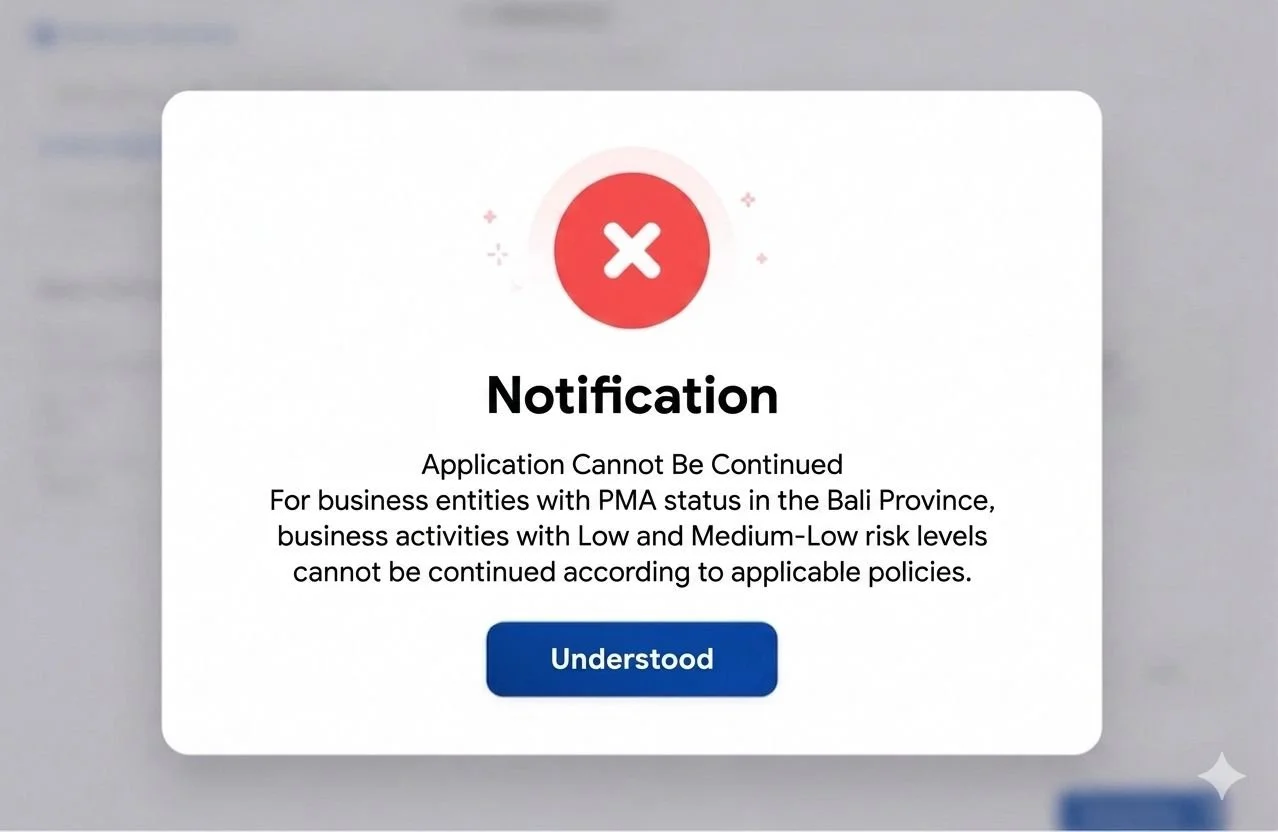
The restrictions were implemented immediately within the OSS system, leaving many planned PT PMA applications unable to proceed.
Instead, on May 13, 2026, the Ministry of Investment validated the letter and instantly hardcoded these restrictions directly into the live OSS system. Overnight, the platform's rules changed without warning, leaving many investors who were in the middle of preparing their corporate setups completely stranded.
Is Bali Closed to Foreign Investors?
Foreign investment in Bali hasn't stopped entirely. You can still invest in a business which is considered medium-high risk or high risk, but doing so will come with a significantly more involved licensing process.
The sectors still open include:
Restaurants and bars (KBLI 56101 / 56301)
Medical Spa services (KBLI 96122)
Property brokerage (KBLI 68200)
Large-scale hotels with a building area exceeding 6,000 sqm
To register for these categories, your certificate will need to be reviewed and approved by the correct central government ministry in Jakarta, so approvals can take a while. There aren’t set timelines, and the time it takes to be processed ultimately depends on the type of business, how completely your documentation meets the requirements, as well as the workload of the ministry handling your application. Furthermore, because these ministries often lack a straightforward legal infrastructure for these newly rerouted applications, it frequently results in a complicated back-and-forth process to get things finalized. In most cases, it can take months or longer.
Are Existing Businesses Affected?
If your PT PMA already has an active KBLI at its registered business location, you won’t be affected. Your existing classification stays in place without any changes but your business may face some limitations due to this new regulation.

Existing PT PMAs can continue operating normally, provided their KBLI is already active at their business location (not virtual office address).
Expanding your business to a new location is now no longer possible if you’re operating in a blocked category. Even if your current KBLI is already active at your existing address, you cannot activate the same classification at a new address anywhere in Bali.
What About Opening a Business Outside of Bali?
This new regulation only applies to Bali, not the whole of Indonesia. Low-risk and lower-medium risk KBLI business activations are still allowed in other areas of Indonesia, as long as your business complies with local requirements.
Can’t I Just Register in Jakarta?
Registering your company at an address in Jakarta while actually running your business in Bali is illegal. Every KBLI classification has to be activated at the location the business operates from day to day. So, if you’re running a business in Bali, that's where the activation needs to be, even if the company was originally set up in Jakarta.
What’s Ahead: The Future of Bali Investment
This regulation is a big step that fundamentally changes what is available to foreign investors looking to start new businesses in Bali. However, there is a strong beacon of hope on the horizon for foreign business owners.

Upcoming KBLI 2025 reforms may introduce new classifications and potentially create alternative pathways for foreign investors.
The Indonesian government is preparing for a transition to the upcoming KBLI 2025 framework, which will trigger a massive relaunch of the OSS system. This update introduces several critical shifts that could re-open options for foreign investors:
New Classifications Arriving: Entirely new business codes will be introduced, which could completely re-define how specific commercial activities are categorized in Bali.
Risk Level Re-Shuffling: Under the new framework, some activities that are currently classified as low-risk may be upgraded to Medium-High or High-Risk levels. Because the current Bali ban only blocks the two lowest risk tiers, this re-shuffling could potentially re-open sectors that are currently blocked.
Access is Not Guaranteed: Keep in mind that even if a new code is classified under the high-risk path, the central government will still determine whether it is fully open to foreign investment or strictly reserved for 100% local ownership.
If you are still exploring your options or already have a corporate structure in mind, it is highly worth getting professional clarity before committing to a commercial lease, a business purchase, or any other major step.
If you would like help working out where your business sits under the current regulations or exploring your alternative strategic options, get in touch with the team at Bali Solve. You can reach us via WhatsApp or visit our office in Pererenan, near Canggu, where we’ll be more than happy to help you find the right solution for your business plans.
Frequently Asked Questions
Q: Does this regulation affect my existing PT PMA?
A: As long as your KBLI is already active at your business location, this regulation won’t affect your PT PMA.
Q: Can I expand my existing business to a new location in Bali?
A: Not if your KBLI falls under a low-risk or lower-medium-risk category. Activating a new location under these categories is not allowed anywhere in Bali.
Q: Can I open a low-risk business outside Bali?
A: Yes. This regulation applies only to Bali Province, whereas other areas of Indonesia remain open to foreign investors.
Q: How long does the licensing process take for medium-high or high-risk categories?
A: There is no fixed timeline. The process is handled centrally by the relevant government ministry in Jakarta and depends on the type of business and whether all submitted documentation fully meets the required standards.
Q: Can I register my company in Jakarta and operate in Bali?
A: Your KBLI must be activated at the address where your business actually operates. Registering elsewhere while running your business in Bali is illegal.
Q: Until when does this ban last?
A: There is currently no official expiration date for these restrictions. The automated block inside the OSS system will remain in place indefinitely, until the Governor of Bali issues a new directive requesting the central government to lift or relax the rules. Given the local government's current stance on tightening compliance, these measures are expected to stay active for the foreseeable future.
Written by Bali Solve Team
01st June 2026